The Call That Still Makes Me Cringe
A few winters ago, I got a call from a homeowner in Green Bay who said, “I think I broke my garage door spring — but don’t worry, I already bought a replacement and started working on it.”
That sentence always gives me chills.
By the time I arrived, his ladder was still standing, a winding bar halfway inserted into the spring cone. He was lucky — the spring had slipped during tensioning, but he’d jumped back in time to avoid being hit.
When I looked at the setup, I saw three things immediately: the wrong spring size, uneven tension, and a cable that had jumped its drum.
That single attempt at a garage door torsion spring replacement had just turned into a full rebuild.
He sighed and said, “I just wanted to save a few bucks.”
That day reminded me why I’m so passionate about educating homeowners:
Torsion spring replacement isn’t about saving money — it’s about protecting yourself, your family, and your door.
Let’s talk about why DIY spring work often costs more — in time, safety, and repair.
1. Understanding What a Torsion Spring Actually Does
Most people think the opener lifts the door.
It doesn’t. The torsion springs do nearly all the work — the opener just guides the motion.
Each torsion spring is tightly wound around a steel shaft above the door, storing rotational energy that counterbalances the door’s weight.
When installed correctly, the door feels almost weightless, even though it can weigh 150–300 pounds.
That’s the magic of precision tensioning.
But when you do garage door torsion spring replacement yourself, you’re dealing with stored energy powerful enough to shatter metal or send tools flying if mishandled.
That’s not an exaggeration — it’s physics.
I’ve seen winding bars launch across garages, cables snap like whips, and in one case, a cracked panel from an uneven lift.
Every inch of that spring’s motion carries hundreds of pounds of force.
That’s why professionals treat every turn with respect, not overconfidence.
2. The Hidden Cost of a “Quick Fix”
When you buy a spring from a hardware store or online, you’re not getting a custom-fit component — you’re getting a guess.
Torsion springs are sized based on door weight, height, track radius, and drum diameter.
Even a one-inch difference in coil size or wire gauge can throw off the entire balance.
That imbalance doesn’t just affect how smoothly the door moves — it shortens the lifespan of every part in the system.
So when someone tells me, “I did my own garage door torsion spring replacement and it works fine,” I always ask,
“Does it still balance halfway open?”
Because “working fine” doesn’t mean “working right.”
And what seems fine today could become an opener burnout or cable failure tomorrow.
The repair you thought saved money can quietly create hundreds of dollars in hidden wear.
3. Why Professional Replacement Is About Math, Not Muscle
There’s a myth that torsion spring work is just about strength or courage — it’s not.
It’s about math.
Every spring has a torque constant — the precise relationship between how much it’s wound and how much force it exerts.
That calculation depends on wire diameter, coil count, door weight, and drum circumference.
When we perform a professional garage door torsion spring replacement, we don’t guess — we measure.
We weigh the door on a digital scale, record travel distance, and match springs to within ¼-inch of manufacturer spec.
That’s why professional installations open smoothly, close quietly, and stay balanced for years.
Precision beats muscle every time.
4. The Counterintuitive Truth: Stronger Springs Aren’t Safer
I often hear homeowners say, “Can you just install a stronger spring so this doesn’t happen again?”
It sounds logical — but it’s actually dangerous.
If a spring is too strong, it can lift the door unevenly or cause it to “fly open” uncontrolled. That leads to damaged panels, overstressed openers, and, in some cases, doors that refuse to stay closed.
The goal of a garage door torsion spring replacement isn’t brute strength — it’s perfect balance.
A door that stays put halfway open, without rising or falling, is the mark of a job done right.
That’s why professionals always replace springs in matched pairs — same wire size, coil count, and torque rating.
You can’t “upgrade” balance. You can only tune it.
5. Why Green Bay Weather Demands Extra Care
In Wisconsin, torsion springs don’t just wear — they age faster.
Cold weather makes steel contract and lose elasticity.
Humidity encourages rust inside the coils, weakening the metal from within.
Add road salt and condensation, and you’ve got a perfect storm for premature failure.
That’s why every garage door torsion spring replacement we perform in Green Bay includes protective steps like:
- Applying silicone-based, cold-rated lubrication
- Installing coated springs resistant to corrosion
- Adjusting tension for winter contraction
It’s not just about replacing — it’s about conditioning the system for local weather.
Because a spring installed perfectly in July can snap by February if it’s not climate-calibrated.
6. The Moment of Truth: When to Replace vs. When to Tune
Not every noisy door means you need a replacement.
Sometimes, your springs just need a tension adjustment.
Here’s how I explain it:
If the door feels heavier, jerks open, or makes a loud ping at the start of motion — it’s time for professional inspection.
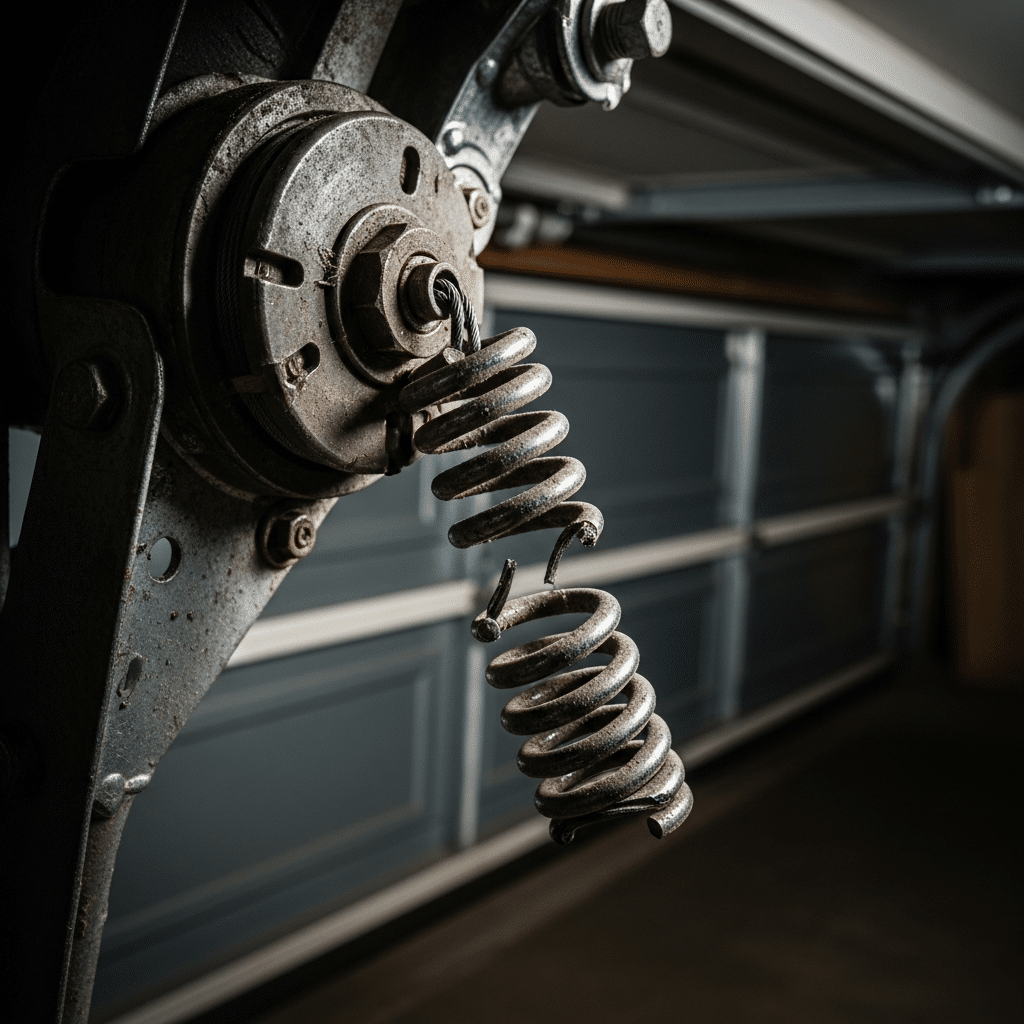
If a spring visibly separates, uncoils, or breaks in two, that’s replacement time.
The problem is, most homeowners can’t tell the difference — and that’s okay.
That’s what we’re here for.
7. The Three DIY Myths That Cause the Most Damage
I’ve lost count of how many garage doors I’ve had to rebuild because of these three common misconceptions.
Myth 1: “You Can Just Count the Turns.”
Many DIY videos suggest winding your spring “X number of turns per foot of door height.”
That formula ignores wire gauge, door weight, and drum size — the very details that determine balance.
Get it wrong, and your door either won’t open fully or will rocket upward dangerously fast.
Myth 2: “You Only Need to Replace One.”
As I mentioned earlier, springs age in pairs. Replacing one fresh spring alongside one worn spring creates uneven tension — which doubles wear and halves lifespan.
I’ve seen brand-new springs fail in months simply because they were paired with an old partner.
Myth 3: “Lubrication Fixes Everything.”
Lubrication is essential — but it’s maintenance, not a cure.
If a spring’s coils are already fatigued or corroded, no amount of lubricant will reverse that damage.
It may even mask the sound of metal fatigue long enough for the break to surprise you.
When it comes to garage door torsion spring replacement, the right information is just as important as the right tools.
8. What Professionals Do That DIY Can’t
When we handle a garage door torsion spring replacement at WI Garage Door LLC, it’s not guesswork — it’s calibration.
Here’s what that looks like:
- Precision Measurement. We measure the exact door weight with tension gauges, not estimates.
- Spring Matching. Every replacement is matched to the door’s balance, travel distance, and torque curve.
- Controlled Winding. We use calibrated winding bars with measured tension increments — never drills, never shortcuts.
- Cable and Drum Inspection. Every supporting component is checked for wear or misalignment.
- Safety Testing. Once the spring is set, we test reversal, travel limits, and force sensitivity.
- Climate Conditioning. For Green Bay, we adjust tension to compensate for winter contraction and apply silicone-based lubricant.
It’s a combination of science, craftsmanship, and respect for the forces at play.
That’s what separates a temporary fix from a lifetime solution.
9. The Hidden Risk Few Homeowners Realize
Even if a DIY spring replacement seems successful, the danger often comes later.
An improperly balanced door doesn’t fail immediately — it wears everything else down faster.
The opener motor strains harder. The bearings wear unevenly. The tracks shift slightly over time.
Then one cold morning, the door jams halfway.
The opener hums. The cables twist.
And you’re back at square one — but now it’s not just a spring job; it’s a system rebuild.
That’s why I say with confidence:
The most expensive repair is the one that follows a “cheap” one.
10. The Counterintuitive Truth: The Quieter the Door, the Smarter the Work
Most homeowners think a quiet door means everything’s fine.
But in my experience, silence isn’t always safety.
A perfectly silent door can still hide imbalance — it’s just being overpowered by the opener.
During every garage door torsion spring replacement, I disconnect the opener and test the door manually.
It should lift easily with one hand, pause halfway, and close smoothly without falling.
That’s what true balance feels like.
And when it’s balanced, every part lasts longer — springs, rollers, cables, and opener alike.
Quiet should be earned, not forced.
11. How to Extend the Life of Your New Springs
A professional replacement is the best investment you can make — but even then, maintenance matters.
Here’s what I tell every Green Bay homeowner after a garage door torsion spring replacement:
- Lubricate Twice a Year.
Use a silicone-based spray in spring and fall. Avoid heavy oils that attract dust. - Schedule a Yearly Tune-Up.
A quick check and balance test can prevent 90% of future issues. - Listen for Changes.
Springs “speak” through sound — squeaks, clunks, or rhythmic pings mean tension or alignment is off. - Don’t Overuse the Door in Cold Weather.
Metal fatigue accelerates in freezing temps. If your door is slow to move on a bitter day, give it a break. - Keep the Area Clean.
Dust and salt near the springs cause corrosion. Wipe the area periodically.
These small habits can extend your spring life by years.
And they cost nothing but a few minutes of care.
12. The Green Bay Factor: Why Local Knowledge Matters
I’ve worked on garage doors in multiple states, and no environment challenges metal quite like Wisconsin’s.
The freeze-thaw cycles, salt, and humidity create a unique stress pattern on every coil and cable.
That’s why local experience matters.
When you hire a true Green Bay professional, you’re hiring someone who’s seen what winter does to steel — and knows how to prevent it.
At WI Garage Door LLC, we don’t just install springs.
We engineer solutions built to last through a Wisconsin decade.
That means using corrosion-resistant coatings, seasonal recalibration, and precision tools tested in the same climate you live in.
13. The Human Side of the Work
Every now and then, I think back to that first call — the homeowner with the ladder and the half-wound spring.
He ended up fine, thankfully. But what stuck with me most wasn’t the repair — it was what he said afterward.
He looked at me and said, “I thought it was just a spring.”
That’s what most people think. Until they realize that the spring is what makes everything else possible.
The door. The opener. The safety. The convenience.
It all depends on one small coil of steel doing its job perfectly — every single day.
And that’s why we treat every garage door torsion spring replacement like a precision operation, not a routine task.
Because in this line of work, “good enough” isn’t good enough.
14. The Mentor’s Perspective: When It’s Worth Doing Right
After decades in this trade, I’ve learned that what homeowners really want isn’t just a quiet door — it’s peace of mind.
When you press that button, you want reliability.
You want to know it will open for you every morning and close safely every night.
That peace doesn’t come from cutting corners — it comes from doing the job right, once.
So if you’re reading this and thinking about tackling garage door torsion spring replacement on your own, my advice is simple:
Call someone who’s done it a thousand times.
Let experience protect you.
Because the best savings aren’t in skipping a service — they’re in never needing the same one twice.
Final Thoughts: Green Bay’s Trusted Experts in Torsion Spring Replacement
Your garage door springs are more than metal — they’re the heartbeat of your entire system.
When they’re balanced, everything works in harmony. When they’re not, everything suffers.
At WI Garage Door LLC, we specialize in precision, safety, and reliability.
Every garage door torsion spring replacement we perform in Green Bay includes careful calibration, full-system inspection, and climate tuning for Wisconsin weather.
Because your garage door doesn’t just need to open — it needs to open right, every time.
Call WI Garage Door LLC — Green Bay’s trusted experts for garage door torsion spring replacement, professional tune-ups, and full balance restoration.
Safe. Accurate. Done right — the first time.