The Morning That Started Like Any Other
It was a cold Green Bay morning when a homeowner called me, sounding frustrated.
“My car’s stuck,” he said. “The door won’t move, and I think the spring snapped.”
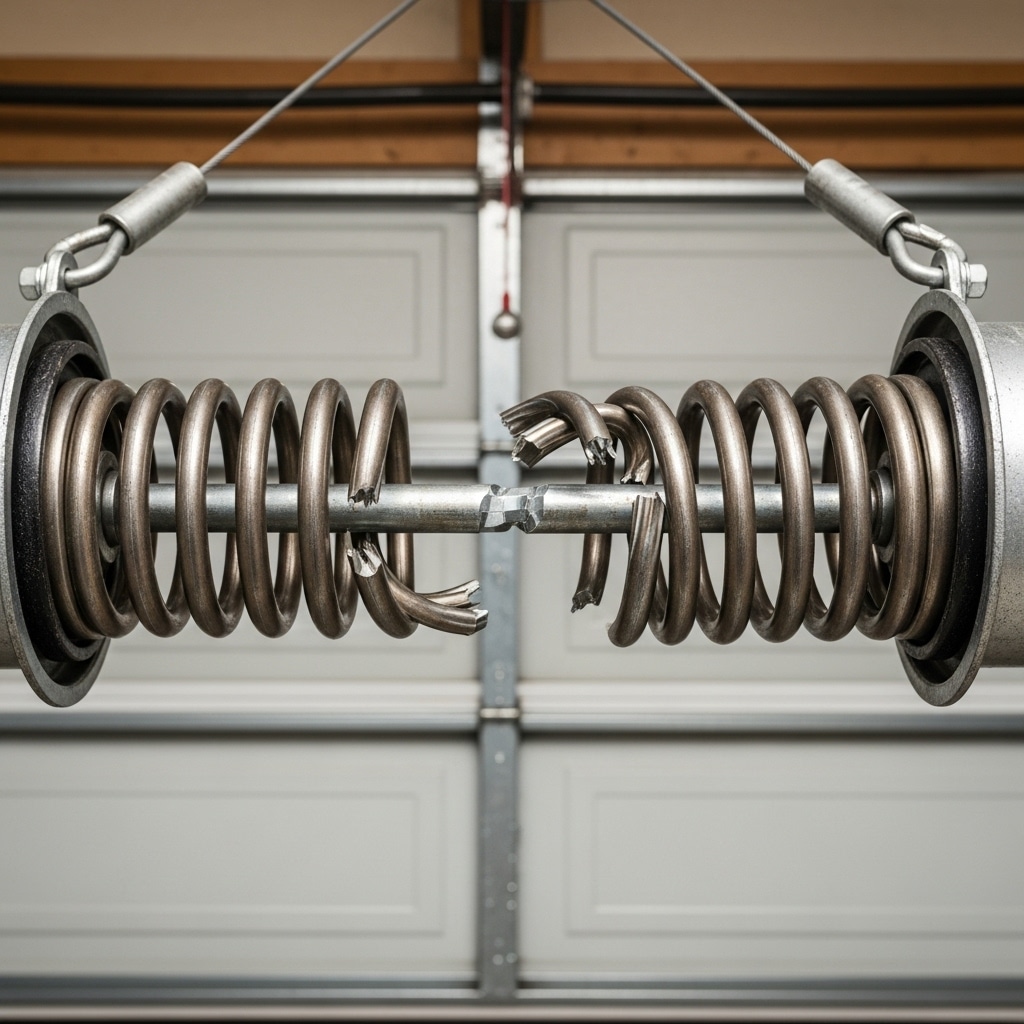
When I got there, I saw the familiar sight: one torsion spring split in half, the other stretched tight under strain.
He looked at me and asked the same question I hear at least five times a week:
“How long does it take to replace garage door springs?”
I smiled — because it’s a fair question, and one most people only think about when their garage door refuses to open.
The short answer?
It usually takes between 60 and 90 minutes for a professional to replace both springs safely.
But that simple answer hides a lot of moving parts — literally.
So let’s break down what really determines that timeline… and what can turn a one-hour job into an all-day headache.
1. The Simple Answer (and the Real One)
Most people expect a quick fix — and under ideal conditions, that’s true.
A standard torsion spring replacement on a well-maintained door can take about an hour.
But the real question isn’t how long does it take to replace garage door springs — it’s what’s the condition of the system when we start?
Because no two doors are identical.
One might be perfectly balanced and easy to access; another might have rusted drums, stripped cones, or mismatched springs from a previous repair.
In other words, the time it takes depends less on speed… and more on precision.
2. What Professionals Actually Do During That Hour
When homeowners ask me why it takes an hour when “it looks so easy online,” I walk them through the real process.
Here’s what goes into every spring replacement we do at WI Garage Door LLC:
- Disconnect the power and secure the door. Safety first — we clamp the door to prevent it from falling when tension is released.
- Release existing spring tension. This is the most delicate step — one wrong move here can turn a bar into a projectile.
- Remove the old springs and bearings. Depending on rust and age, this can take 5 or 15 minutes.
- Inspect cables, drums, and center bearing plates. If they’re frayed or worn, we replace them to prevent future failure.
- Install new torsion springs. Always in matched pairs, and always sized precisely for the door’s weight.
- Wind the springs to correct torque. This is where expertise matters — every quarter-turn counts.
- Balance-test the door manually. It should stay still halfway open — that’s how you know it’s calibrated.
- Reconnect and adjust the opener. We set proper force limits and safety reversal functions.
That’s how you turn a dangerous repair into a reliable system.
The goal isn’t just to replace — it’s to restore balance and safety.
3. Why DIY Usually Takes Four Times Longer
When I hear that someone tried to do it themselves, I already know what happened.
A 90-minute job became a weekend project.
Because without the right tools or experience, every step takes longer — and carries more risk.
I’ve been called to homes where:
- A DIYer couldn’t remove rusted cones and spent two hours hammering.
- A mismatched spring set caused the door to tilt.
- A winding bar slipped and bent the shaft, adding three more hours to the repair.
So when people ask how long does it take to replace garage door springs by yourself, the honest answer is:
“It depends on how much trouble you run into — and how safely you can stop when you do.”
What takes a professional 90 minutes can take an inexperienced homeowner 6 to 8 hours — if they get through it at all.
4. The Counterintuitive Truth: Faster Isn’t Safer
A lot of homeowners are surprised when they see how methodical we are.
We don’t rush, even though we could.
Because with springs, speed kills — literally.
Every movement when replacing springs is measured, tested, and verified.
I’ve replaced thousands of springs in Green Bay, and the biggest lesson I’ve learned is this:
“The slower you go, the faster the door will last.”
That’s why a one-hour job done correctly will outlive a 30-minute “quick fix” every time.
So if a company ever promises spring replacement “in 20 minutes flat,” that’s not efficiency — that’s recklessness.
5. The Weather Factor: Why Wisconsin Adds 15 Minutes
In Green Bay, even the temperature can affect how long the job takes.
Cold steel tightens.
Bolts seize.
Lubricant thickens.
That’s why winter jobs can take longer — up to 90 minutes instead of 60.
And honestly, I prefer it that way.
Because when the air is below freezing, I take extra care to warm and lubricate each coil before tensioning.
That small detail prevents micro-cracks that can shorten a spring’s life by years.
So when a homeowner asks how long does it take to replace garage door springs in February, I tell them:
“Long enough to make sure it works in February next year, too.”
6. The Role of Preparation and Maintenance
Sometimes the biggest time-saver isn’t during the repair — it’s in what happened before it.
A door that’s maintained regularly will always take less time to service.
Clean bearings, lubricated springs, and aligned tracks reduce friction and make adjustments faster.
That’s why I always recommend a preventive maintenance schedule.
It’s not just about avoiding emergencies — it’s about making the inevitable repair faster, safer, and cheaper.
So yes, how long it takes to replace garage door springs depends partly on how well you’ve treated the door leading up to that moment.
7. Real-World Examples: When Everything Goes Right — and When It Doesn’t
Let me give you two real-life examples from Green Bay that explain why “how long does it take to replace garage door springs” is such a loaded question.
Case 1: The Perfect Door
Last spring, I replaced a set of torsion springs on a three-year-old double door in Howard. The homeowner had regular tune-ups, kept it clean, and called immediately after hearing the telltale bang of a broken spring.
Everything was well-maintained — bearings clean, cables aligned, no rust.
From start to finish, it took me just under 55 minutes.
Smooth, safe, predictable.
That’s the best-case scenario — when care and timing make the job straightforward.
Case 2: The Rusted Surprise
Now compare that to a call in winter.
A 20-year-old door that hadn’t been serviced in a decade. One spring snapped, and the other was barely holding.
The set screws were rusted solid; the shaft was seized; one cable drum had cracked.
Between breaking everything loose safely, sourcing the right parts, and resetting the system, that job took nearly three hours.
Both homeowners got their doors fixed — but one paid for preparation, the other paid for neglect.
8. The Top 5 Factors That Change the Timeline
If you want the most accurate answer to how long does it take to replace garage door springs, these are the five factors that matter most:
1. Door Type and Size
Single doors are faster than doubles. Heavier insulated or wood doors require higher-torque springs, which take more winding and balance testing.
2. Age of the System
The older the hardware, the more likely it is that bolts will strip, bearings will seize, or shafts will rust. That’s what adds time — not the spring itself.
3. Spring Type
Torsion springs (mounted above the door) take longer than extension springs (on the sides) but provide smoother, safer operation. Most modern homes use torsion setups — which is why that 60–90-minute range applies.
4. Condition of the Bearings and Cables
If the door’s been making grinding or scraping sounds, expect extra time for cleanup or replacements. It’s better to fix those now than risk a future failure.
5. Technician Experience
This one’s huge.
An experienced tech doesn’t just work faster — they work smarter.
They can tell, just by feel, whether a spring is wound correctly or a shaft is slightly bent. That kind of intuition saves time, avoids damage, and ensures the door balances perfectly the first time.
At WI Garage Door LLC, I’ve personally replaced thousands of springs. Every single job follows the same principle: measure twice, wind once, test always.
That’s how you earn speed through skill, not shortcuts.
. What Happens After the Springs Are Replaced
A lot of people think the job ends when the new springs are on.
But the truth is, the most important part happens afterward — the testing.
After installation, we:
- Lift the door manually halfway to check balance.
- Run it through full travel cycles to ensure no friction or binding.
- Test the opener’s force sensitivity so it reverses if it senses resistance.
- Lubricate the coils with silicone to prevent rust and friction buildup.
This testing phase only takes 10–15 minutes — but it’s where a good job becomes a great one.
It’s also why I tell customers:
“If your tech replaces your springs and leaves in under 30 minutes, they didn’t test your door — they gambled with it.”
10. The Counterintuitive Truth: The Real Time-Saver Is Maintenance
Here’s the part most homeowners don’t expect — the best way to make future spring replacements faster is simple: maintenance.
When your door is lubricated twice a year, the system stays flexible.
When you schedule annual tune-ups, we can spot small issues — like fraying cables or loose set screws — before they become time-consuming repairs.
That’s how we turn “a 3-hour ordeal” into “a 45-minute visit.”
So if you ever find yourself wondering how long does it take to replace garage door springs next time, the answer might just depend on how well you’ve taken care of them this time.
11. The Myth of the “Quick Fix”
Some companies advertise same-day spring replacement “in 20 minutes or less.”
Let me be blunt — that’s a red flag.
A rushed spring job might look done, but it’s rarely balanced correctly.
And when springs are off by even one-quarter turn, it strains your opener, warps your panels, and wears down the bearings.
Fast repairs feel satisfying in the moment, but they’re costly in the long run.
That’s why, when someone asks me how long does it take to replace garage door springs, I say:
“As long as it takes to make it last.”
12. What Can Go Wrong — and How to Prevent It
Let’s talk about what actually goes wrong during or after a rushed job:
- Uneven Lift: One side of the door rises faster, twisting panels.
- Snapped Cable: Caused by improper drum alignment or uneven torque.
- Burned-Out Opener: The motor compensates for imbalance until it fails.
- Premature Spring Fatigue: Over-tensioned coils lose elasticity faster.
- Door Slam: Under-tensioned springs can’t support weight, leading to dangerous drops.
Each of those can turn a one-hour service call into a full rebuild.
That’s why I don’t sell “speed.” I sell stability.
13. The Green Bay Perspective: Why Local Conditions Matter
Green Bay’s environment is tough on garage doors.
Between salt from the roads, moisture from Lake Michigan, and winter freezes, even the best springs need special care.
That’s why all our replacements include:
- Cold-rated torsion springs designed for subzero resilience
- Anti-corrosion coatings to resist rust
- Seasonal tension calibration — because metal expands and contracts with temperature
These steps might add 10–15 minutes to the job, but they add years to your system’s life.
That’s the kind of trade-off I’ll take every time.
14. The Human Side of Precision
Sometimes, when I finish a spring replacement, the homeowner watches me run the final test and asks, “That’s it?”
And I always smile.
Because when it’s done right, it looks easy.
That’s the beauty of craftsmanship — it hides the complexity behind calm confidence.
It’s the difference between someone who replaces a part… and someone who restores your peace of mind.
That’s what we do at WI Garage Door LLC.
We don’t race the clock — we respect it.
15. The Real Answer: Time Well Spent
So, how long does it take to replace garage door springs?
For a professional: about an hour.
For someone untrained: possibly an entire weekend.
For a rushed job: 20 minutes now, 3 hours later.
The real measure isn’t the stopwatch — it’s the lifespan that follows.
Every extra minute spent balancing, testing, and calibrating adds months — sometimes years — to your system’s performance.
So, if you ever find yourself impatient during a service call, remember:
“A few extra minutes today can save you a broken spring, a damaged opener, or a stuck car tomorrow.”
That’s not delay — that’s craftsmanship.
Final Thoughts: Trust the Experts Who Value Time and Safety
Replacing garage door springs isn’t about speed — it’s about trust, precision, and timing.
Done right, it’s a one-hour investment that protects your home for years.
Done wrong, it’s a moment that can turn costly or dangerous fast.
At WI Garage Door LLC, we take our time where it matters — because your door, your safety, and your confidence deserve it.
Call WI Garage Door LLC — Green Bay’s trusted specialists in garage door spring replacement, seasonal maintenance, and balance calibration.
Careful work. Reliable timing. Results that last.