The Call That Stopped Me in My Tracks
A few years ago, I got a call from a homeowner in Green Bay who said, “Hey, I started a spring replacement myself, but the door’s stuck halfway — can you finish it?”
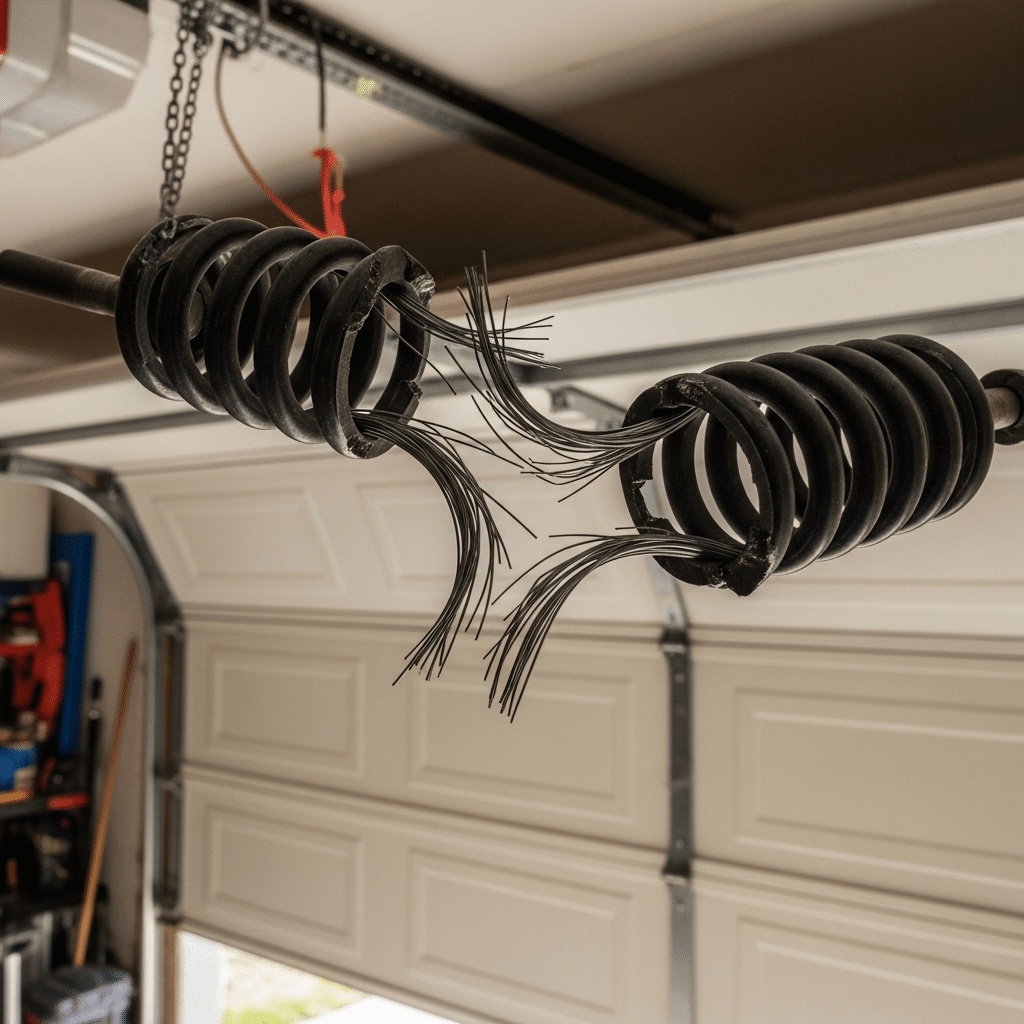
When I arrived, I saw a ladder, a couple of tools, and a spring that looked like it had been halfway wound — dangerously tight, uneven, and ready to snap.
He was lucky he stopped when he did.
When I asked what happened, he said, “I watched a few videos. They made it look simple — two bars, a few turns, done.”
That line sums up the problem with DIY garage door spring replacement — it looks easy until you’re standing inches away from hundreds of pounds of stored torque, hoping your next move doesn’t make it explode.
And the truth is, those online tutorials never show what happens when something goes wrong.
That’s why I always tell homeowners:
DIY isn’t cheaper if you have to call for help after something breaks — or worse, if you get hurt trying.
Let’s pull back the curtain on what really goes into spring replacement, and why professional experience is the difference between “done” and done right.
1. Why Springs Are the Most Dangerous Part of Your Door
Your garage door might look like a big, harmless sheet of panels — but it’s powered by one of the most tension-loaded systems in your home.
Each torsion spring is wound tightly around a steel shaft, holding enough force to lift 150 to 300 pounds of solid weight dozens of times a day.
That stored energy is what makes your door feel light when you open it — but it’s also what makes DIY garage door spring replacement so risky.
If a bar slips, a cone cracks, or a hand tool is used instead of a winding bar, that force has to go somewhere — and physics doesn’t care what’s in the way.
I’ve seen wrench handles fly through drywall, cables snap back like whips, and one instance where a homeowner’s opener bracket was ripped clean off the ceiling.
It’s not drama — it’s the reality of misapplied torque.
Professionals train to handle that tension with precision, not guesswork.
That’s why every turn, every click, every safety test matters.
2. The Illusion of “Simple” in Online Tutorials
It’s easy to see why DIY spring jobs are so tempting — YouTube makes them look effortless.
Two tools, one ladder, a confident voiceover — what could go wrong?
But here’s what those videos don’t show:
- The spring winding off-center and locking under load
- The cable slipping from the drum mid-turn
- The shaft flexing under torque
- Or the instant a cone strips its set screw and everything unravels
That’s when homeowners call me, usually with the same words: “I almost had it.”
What they don’t realize is that garage door torsion springs are engineered systems, not universal parts.
Each one is calculated for your door’s specific weight, travel distance, and drum diameter.
Even being off by a single wire gauge can throw the balance out completely.
That’s why professional spring replacement is part math, part craftsmanship, and part safety engineering.
It’s not that you can’t try it — it’s that you shouldn’t have to.
3. The Counterintuitive Truth: It’s Not Just the Spring
One of the biggest misconceptions about DIY garage door spring replacement is that the spring is the only problem.
But in most cases, it’s a symptom — not the source.
When a spring breaks, it’s often because of something else:
- A misaligned track putting uneven pressure on the coils
- A worn center bearing
- Rust or corrosion from humidity
- An opener with too much force setting
If you only replace the spring, the root cause remains — and your “fix” fails again in months.
That’s why, at WI Garage Door LLC, we never replace a spring without inspecting the entire lift system — cables, bearings, shaft, opener, and tracks.
The door is a single ecosystem, and balance is what keeps it alive.
A DIY fix might restore motion, but it rarely restores harmony.
4. Why Incorrect Winding Is a Silent Killer
Let’s say you manage to install new springs and wind them without anything breaking — that’s already impressive.
But here’s where things usually go wrong later: tension mismatch.
Springs must be wound to exact torque levels. Too few turns, and the door falls fast; too many, and the door rises uncontrollably.
Both extremes destroy openers, bearings, and even panels over time.
Professional techs use calibrated winding bars and count tension turns relative to the spring’s specifications — not guesswork, not “it feels right.”
Because when you’re dealing with stored kinetic energy, feeling right isn’t good enough.
Even half a turn too tight can turn your opener’s gear into dust within months.
That’s why every DIY garage door spring replacement that “works fine” worries me — because it’s rarely balanced perfectly.
It’s like driving on four tires, one of which is slightly flat. It rolls — but not for long.
5. The Real Cost of “Saving Money”
Let’s break this down honestly.
A quality torsion spring costs about what most homeowners think — not cheap, but not outrageous.
But the hidden cost of doing it yourself? That’s where the numbers get painful.
Add it up, and that “cheap” project turns into the most expensive free weekend you’ve ever had.
That’s why professional service is less about cost and more about control.
You’re not paying for labor — you’re paying for precision, insurance, and peace of mind.
Because replacing a spring correctly once always costs less than replacing three parts twice.
6. Why Green Bay’s Weather Makes DIY Even Trickier
If you’ve lived through a Green Bay winter, you know what cold does to metal — it contracts, hardens, and snaps easier under stress.
That means springs here are under extra tension every winter.
So when someone attempts DIY garage door spring replacement in freezing weather, they’re working against the material itself.
I’ve had calls where springs fractured mid-install because the metal was brittle from subzero temps.
That’s not something you can predict — but professionals plan for it.
At WI Garage Door LLC, we only install cold-rated, corrosion-resistant springs built for Wisconsin’s climate.
We also use silicone-based lubrication, not oil-based — because oil thickens in cold and can actually trap moisture inside the coils.
It’s details like these that turn a risky repair into a system built for endurance.
7. The Three Most Dangerous DIY Mistakes
When people ask me what makes DIY garage door spring replacement so dangerous, I don’t point to rare freak accidents.
I point to the common mistakes — the ones that happen every weekend, in every garage, to well-intentioned homeowners.
Mistake #1: Using Improper Tools
A wrench, screwdriver, or socket extension is not a winding bar.
Torsion springs are wound under hundreds of pounds of pressure.
If the tool slips or bends, that stored energy releases instantly — and I’ve seen even small slips send tools flying across a garage.
Professionals use hardened steel winding bars with specific diameters that fit perfectly into the spring cone.
Each quarter-turn is controlled, measured, and balanced.
There’s no improvisation — only precision.
Mistake #2: Not Securing the Door First
Homeowners often forget that when one spring breaks, the entire door is unbalanced.
If you disconnect the opener or release the tension without securing the door in place, it can crash down under its full weight.
Even a seven-foot steel door can hit the ground in less than half a second.
Before any garage door spring replacement, professionals clamp the door in position, disconnect power, and stabilize the shaft.
That single safety step prevents catastrophic accidents — and it’s one of the first things DIYers overlook.
Mistake #3: Releasing Tension in the Wrong Direction
This one’s subtle, but deadly.
Every torsion spring winds in a specific direction depending on its side of installation.
Releasing or tightening in the wrong direction adds double stress to the metal — twisting it against its natural coil.
Once that happens, you’re seconds away from a break or unwinding snap.
And the worst part? You often don’t know it’s wrong until it’s too late.
That’s why DIY garage door spring replacement is never just about tools — it’s about understanding physics.
8. Why Professional Tools Aren’t Just for Show
When I roll up to a job, homeowners often notice the amount of gear I bring:
tension gauges, torque wrenches, precision winding bars, digital scales.
It’s not overkill — it’s insurance.
You see, every door is different. Even two “identical” 16-foot doors can vary by a few pounds, and that changes everything about how the spring should be calibrated.
A proper garage door spring replacement includes:
- Measuring door weight with a scale
- Selecting spring size based on torque formula
- Setting the correct number of turns
- Adjusting for door travel and opener load
That’s not trial and error — it’s mechanical math.
Without those tools, even a perfectly installed spring can be off-balance, shortening its lifespan by years.
And that’s the kind of precision you can’t eyeball.
9. The Emotional Cost of Shortcuts
I’ve worked with hundreds of homeowners over the years, and I’ve noticed something interesting:
Most people who attempt DIY garage door spring replacement aren’t reckless — they’re responsible.
They’re the kind of people who change their own oil, fix leaky faucets, and take pride in being self-sufficient.
That independence is something I respect deeply.
But garage doors are different.
They don’t forgive small mistakes.
One Green Bay homeowner told me, “I thought it would take an hour. Instead, I ruined a weekend and scared my family.”
That line hit me hard. Because it’s not about skill — it’s about unseen risk.
You can’t see tension. You can’t see metal fatigue.
And that’s what makes this repair so deceptively dangerous.
There’s no shame in calling a professional.
In fact, it’s the smartest kind of responsibility — knowing when to delegate a dangerous job to someone with the right tools and training.
10. The Counterintuitive Truth: The Risk Isn’t Always Immediate
Here’s something most people don’t realize — not all mistakes explode right away.
Sometimes, the damage unfolds slowly.
I’ve been called to homes months after a DIY garage door spring replacement, and the door “still worked.”
But when I inspected it, I found:
- Springs wound unevenly, adding stress to the shaft
- Bearings grinding from off-center torque
- Openers straining under misaligned load
It’s like running your car with the wrong tire pressure — it’ll drive, until it doesn’t.
That’s why the most expensive repair isn’t always the one you botched — it’s the one that “almost worked.”
11. Green Bay’s Unforgiving Climate: The Hidden Enemy
Our Wisconsin winters don’t just test people — they test metal.
Cold steel contracts, humidity seeps into every joint, and condensation corrodes from the inside out.
I’ve seen brand-new springs in Green Bay fail in under three years because they weren’t treated for local conditions.
That’s why at WI Garage Door LLC, every replacement we install includes:
- Cold-rated springs engineered for subzero tension
- Zinc or powder coatings to resist corrosion
- Silicone lubrication that stays flexible through the freeze-thaw cycle
Because here, “good enough” doesn’t survive February.
12. What You’re Really Paying For When You Hire a Pro
When people call for garage door spring replacement, they often ask, “What am I really paying for?”
And my answer is simple: Safety, precision, and longevity.
You’re paying for someone who’s:
- Handled thousands of spring replacements without a single injury
- Measured enough torque to know when a spring feels right
- Seen every failure mode and knows how to prevent it before it starts
You’re paying for insurance that your door won’t collapse, your opener won’t burn out, and your springs won’t fail prematurely.
And yes — you’re paying for peace of mind.
13. The Mentor’s Perspective: Pride in Doing It Right
When I first started in this business, I thought being “good” meant being fast.
Now I know being great means being careful.
Every time I replace a spring, I double-check the balance, test the safety reversal, and watch the door glide silently open.
That silence isn’t luck — it’s precision.
That’s the difference between a fix and a craft.
So when I hear someone say they’re planning a DIY garage door spring replacement, I don’t try to scare them — I try to save them from learning the hard way.
Because in this trade, the best lessons are the ones you don’t have to learn through mistakes.
14. The Peace of Mind That Professionals Deliver
There’s a moment I love after every successful job.
When the door rises smoothly, balanced, quiet — and the homeowner presses the button with confidence for the first time.
That moment means safety. Reliability. Relief.
It’s what every homeowner really wants: not just a working door, but a trustworthy one.
And that’s why calling a professional for spring replacement isn’t about cost — it’s about confidence.
At WI Garage Door LLC, we take that seriously.
Every job is personal, every adjustment deliberate, every test thorough.
Because this isn’t just a repair — it’s your home’s daily safety system.
Final Thoughts: Green Bay’s Trusted Experts in Garage Door Spring Safety
Your garage door springs carry more than weight — they carry trust.
They lift your mornings, guard your nights, and work quietly until the day they don’t.
When that day comes, resist the urge to go it alone.
Because the truth about DIY garage door spring replacement isn’t that it’s impossible — it’s that it’s unnecessary.
Let experts who’ve done it thousands of times handle the danger, precision, and calibration — so you never have to worry about what’s above your head.
Call WI Garage Door LLC — Green Bay’s trusted experts for safe, precise garage door spring replacement and full-system calibration.
Professional care. Local trust. Safety that lasts.